

THE BAYFIELD PENINSULA | 2026 REAL ESTATE MARKET SO FAR
Sixty-two homes have closed across the peninsula so far in 2026. Prices closed anywhere from $5,000 to $724,900 this year, which on its face looks almost meaningless as a range, but it actually says something real: this peninsula isn't one market, it's several, stacked on top of each other by geography, and the address matters just as much as the square footage.
Start with the middle, because that's where most of the activity actually lives. The typical closed sale landed at $230,000, and prices between $200,000 and $250,000 saw more transactions than any other bracket, with $150,000 to $400,000 accounting for the bulk of everything that changed hands. That's the workhorse of this market — modest, in-town homes in Ashland, mostly financed conventionally, closing at or very near their asking price. Ashland alone accounts for more than half of all the closings this year, with a median sale price sitting around $195,000, which tells you this is where the volume is and where the market feels most like a normal, functioning small-city market: plenty of inventory turning over, prices behaving predictably, buyers and sellers landing close to the number they started with.
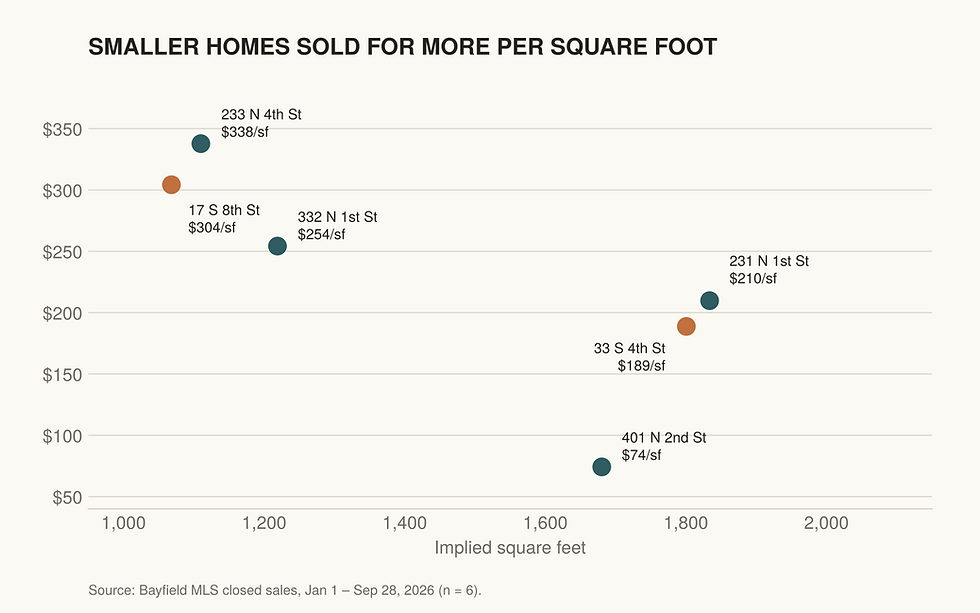
Then there's the coast, and it behaves nothing like Ashland. Herbster and Cornucopia only produced a handful of sales each, but their medians sit at $579,000 and $484,900 — multiples of what's closing a few miles inland. Bayfield itself, with the most sales outside Ashland, carried a median north of $380,000. Every waterfront property that sold this year, and there were eight of them, cleared six figures at minimum, and the true Lake Superior frontage sales ran from $409,000 up to $685,000. Price per square foot is where this split shows up most starkly: the typical home sold for around $150 a square foot, but several of the lakefront properties blew past $300, $350, even $470 a square foot, numbers that have nothing to do with the house itself and everything to do with what's outside its windows. Land tells a similar story on a different axis — most of what sold sits on a fraction of an acre in town, but eight properties this year carried five acres or more, mostly in Bayfield and Washburn, and buyers are clearly paying for the acreage and the privacy as much as the structure.
Speed is the other thread running through this year, and it's a fast one. More than half of everything that sold closed in fourteen days or less, and the median time on market across the entire region was just eight days. Several homes went the same day they were listed. That pace comes with a pricing signal too: the typical sale closed at 98% of its original list price and nearly 99% of its final asking price, meaning sellers who priced accurately weren't leaving much on the table and weren't waiting long to get it. That's a market with real demand behind it, not one where sellers are guessing and hoping.
But the eight-day median hides a tail of properties that took a very long time to sell, and those are worth sitting with, because they're not random. A home in Ashland spent 116 days on market before closing $24,000 under its original list price. A Bayfield property near the water took 93 days and closed $25,000 under ask. Another sat for 94 days and finally moved via a contract-for-deed arrangement rather than a conventional sale. These aren't a separate category so much as a reminder that "the market is fast" is a median, not a guarantee — pricing still has to be right, and properties that miss on price or sit outside what buyers are actively looking for can and do sit for months, even while the property two streets over sells before the sign is fully in the yard.
Financing adds one more layer worth noting: conventional loans carried well over half of all closings, cash was a strong second at roughly a third, and government-backed FHA and VA loans made up a small slice of the rest. That mix leans toward buyers with financing readily available rather than a market propped up by all-cash investors, though cash remains a meaningful and consistent presence, especially at the lower end of the price range where a handful of sales closed well under $100,000 — including one $5,000 lot sale that's really its own category entirely.
Put it all together and this year's market reads as genuinely healthy in its core — fast sales, prices holding near ask, steady conventional financing — while carrying two very different premiums layered on top: a waterfront and acreage premium that can double or triple typical price-per-square-foot numbers, and a patience tax for anything that doesn't fit what buyers currently want at the price it's asking. Ashland is where the volume and predictability live. The coastline and the acreage properties are where the real money and the real waiting both show up.

Comments